Peptides, in plain English: what they are, and why one word covers so much
Insulin is often called a peptide hormone, yet under an FDA rule it counts as a protein. The word "peptide" sits on skincare labels, in gym group chats and in the description of a prescription medicine, and FDA itself says there may be no clear scientific consensus on where the cut-off falls.
Published October 25, 2026. Status is "as of" this date. Sources and retrieval dates are at the bottom. This is not medical advice. The site owner is not a medical professional. Nothing here is a recommendation to use any substance.
The short version
- A peptide is a short chain of amino acids. A protein is a longer one. FDA's 2020 rule treats a chain of more than 40 amino acids as a protein. [V]
- Some peptides are FDA-approved medicines. Others are sold or discussed in wellness circles without any approval for human use. "Peptide" does not tell you which kind you are reading about. [V]
- FDA describes the road to approval as lab studies first, then human trials in phases. A 2025 review of BPC-157, the best-known wellness peptide, found 35 preclinical studies and 1 clinical study. [V]
What a peptide is
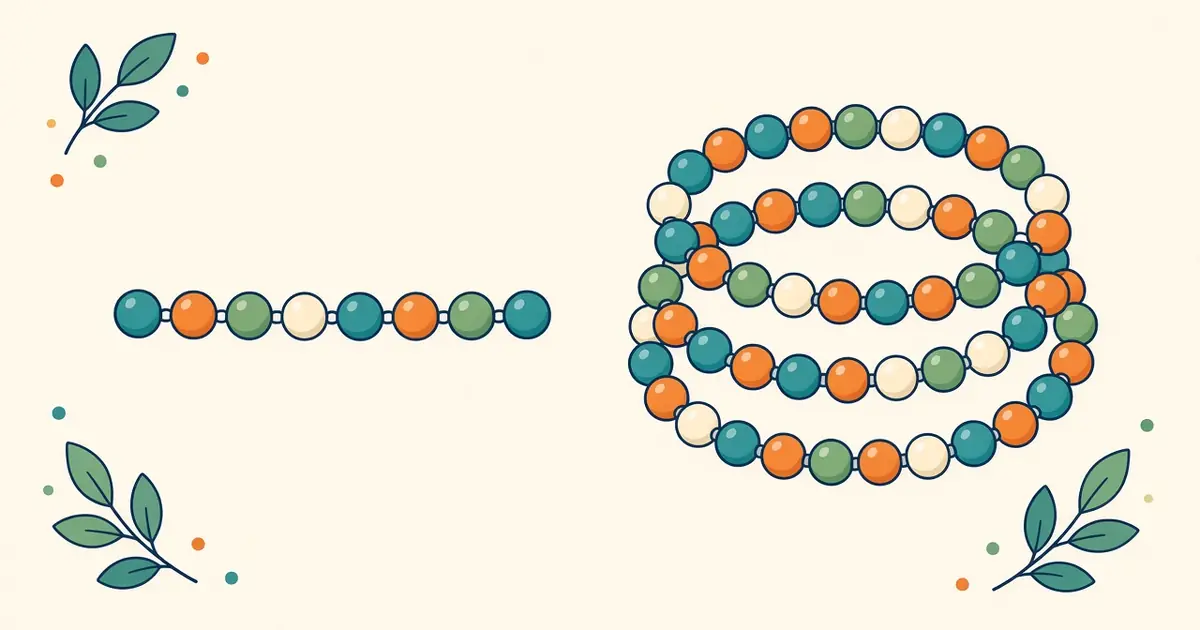
FDA's rule says "peptide," "polypeptide" and "protein" all describe chains of amino acids linked by peptide bonds. Picture the amino acids as beads on a string. A short necklace is what people usually mean by a peptide. A very long string, folded into a complicated shape, is a protein. [V]
That is the whole analogy. The rest of this post is about where the line falls and why it matters to a shopper.
Where the line falls (and why even FDA hedges)
In a 2020 final rule that defined "biological product," FDA said a protein is "any alpha amino acid polymer with a specific, defined sequence that is greater than 40 amino acids in size." The rule took effect March 23, 2020. [V]
FDA was also candid about the limits of that number. In the rule, the agency said "there may not be clear scientific consensus for a particular number of amino acids" separating a peptide from a protein. It said the word "peptide" generally refers to smaller, simpler chains, and "protein" to longer, more complex ones. [V]
Insulin is FDA's own example of the edge cases. The agency described it as two chains, one with 21 amino acids and one with 30. Together that is 51, which is why insulin counts as a protein under the rule even though many people call it a peptide hormone. [V]
Three places you will hear the word
1. Approved medicines. Semaglutide, the active ingredient in Wegovy, is a peptide medicine. Its FDA-approved label describes it as a human GLP-1 receptor agonist and says "The peptide backbone is produced by yeast fermentation." The label lists approved uses, including reducing the risk of major cardiovascular events in certain adults and weight reduction. The label is version 19, published June 30, 2026. [V]
2. Peptides discussed in wellness and fitness circles. BPC-157 is the one you will hear most. A 2025 systematic review in HSS Journal describes it as lacking FDA approval and as banned in professional sports. [V] FDA's advisory committee discussed BPC-157 and six other peptides on July 23–24, 2026. [V] We cover where that stands in our regulation timeline.
3. Cosmetic and food products. Skincare and collagen products also use the word. We have not yet read the primary sources for those, so we make no claims about them in this post. They are on our list.
Why you should care
If you read the word "peptide" on a product page, an influencer's post or a news headline, it tells you almost nothing. It does not tell you whether a medicine is approved, whether any human study exists, or what regulators say. The same word covers a prescription drug with a long FDA label and a compound with no approval for human use.
Asking "which kind of peptide is this?" is the first question that sorts the rest.
What to do with this
These are questions to ask, not advice:
- Which exact substance is it called, and is it the same molecule as an FDA-approved medicine?
- What kind of evidence is behind the claim? People, animals or cells? See our evidence ladder.
- Who is saying it, and what is their source? A label or a post is not a study.
- Is this something to raise with a clinician or pharmacist who knows my health history? They can tell you what applies to you. This site cannot.
What to watch next
- The evidence ladder: what "the research" can and cannot say, using one well-known example.
- Sport rules: what the World Anti-Doping Agency's 2026 list says about peptides, see peptides and the WADA list.
- Coming soon: what "FDA-approved" means for a shopper, and how to read a wellness label.
Where the evidence trail starts
FDA's drug-development pages describe the steps. Before a drug is tested in people, researchers do preclinical research, in vitro (in the lab, outside a living body) and in vivo (in living animals), to find out "whether it has the potential to cause serious harm." Human studies, called clinical research, come after, and FDA says preclinical work is "not a substitute" for them. [V]
For BPC-157, the 2025 HSS Journal review searched the literature through June 3, 2024. It found 544 articles and included 36 studies: 35 preclinical and 1 clinical. Its authors wrote that "No clinical safety data were found." [V] Our next post, the evidence ladder, unpacks what that means.
Sources (all retrieved October 25, 2026)
- FDA, final rule "Definition of the Term 'Biological Product,'" 85 FR 10057, February 21, 2020 [V] — https://www.federalregister.gov/documents/2020/02/21/2020-03505/definition-of-the-term-biological-product
- DailyMed, WEGOVY (semaglutide) injection label, set id ee06186f-2aa3-4990-a760-757579d8f77b, version 19, published June 30, 2026 [V] — https://dailymed.nlm.nih.gov/dailymed/services/v2/spls/ee06186f-2aa3-4990-a760-757579d8f77b.xml
- Vasireddi N, et al., "Emerging Use of BPC-157 in Orthopaedic Sports Medicine: A Systematic Review," HSS Journal, 2025 [V, abstract read on PubMed] — https://pubmed.ncbi.nlm.nih.gov/40756949/
- FDA, "Step 2: Preclinical Research," The Drug Development Process, content current as of 01/04/2018 [V] — https://www.fda.gov/patients/drug-development-process/step-2-preclinical-research
- FDA, "Step 3: Clinical Research," The Drug Development Process, content current as of 01/04/2018 [V] — https://www.fda.gov/patients/drug-development-process/step-3-clinical-research
- FDA, Pharmacy Compounding Advisory Committee briefing document, July 23–24, 2026 [V] — https://www.fda.gov/media/193342/download
Reading this for health reasons? This site reports on regulation; it is not medical advice. See our disclaimer, how we source and corrections policy.